

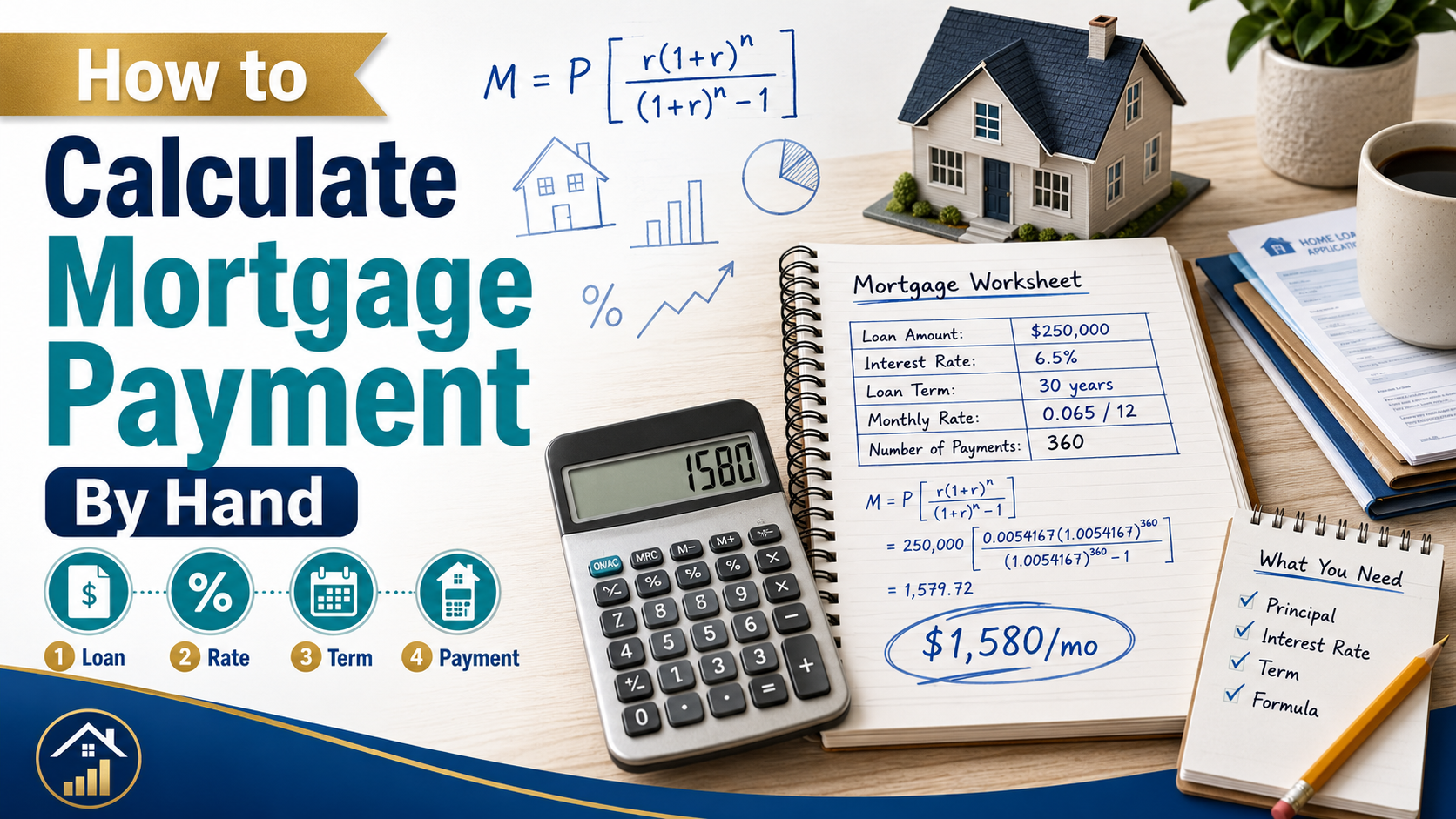
A mortgage payment looks like a single number on your monthly statement, but it is actually the output of a formula juggling your loan amount, interest rate, and term all at once. Understanding how that number gets calculated makes it much easier to see exactly what happens when you adjust your down payment, shorten your term, or shop for a better rate.
The formula behind every mortgage payment
Standard fixed-rate mortgages use what is called an amortization formula:
M = P × [r(1+r)^n] / [(1+r)^n − 1]
- M — your monthly payment
- P — the loan principal (how much you are borrowing)
- r — your monthly interest rate (annual rate divided by 12)
- n — the total number of payments (years times 12)
Working through an example
Say you borrow $300,000 at a 6.5% annual interest rate over 30 years:
- P = 300,000
- r = 0.065 / 12 = 0.00542
- n = 30 × 12 = 360
Plugging those into the formula gives a monthly principal-and-interest payment of roughly $1,896 — before property taxes, homeowners insurance, or PMI are added on top, which most lenders bundle into your total monthly payment.
Why the same loan amount can have very different payments
Interest rate has an outsized effect
On that same $300,000 loan, a 5.5% rate instead of 6.5% drops the payment to around $1,703 — a difference of nearly $200 a month, or over $69,000 across the full 30-year term. This is exactly why even a fraction of a percentage point in rate shopping matters.
Term length trades monthly payment against total interest
Switching that same loan to a 15-year term raises the monthly payment to roughly $2,614, but cuts total interest paid dramatically — the shorter term means far less time for interest to accumulate, even though each payment is larger.
Your down payment reduces P directly
Every dollar you put down reduces the principal the formula runs on, which lowers both your monthly payment and your total interest — and, depending on your loan type, may also eliminate the need for private mortgage insurance.
What the formula does not include
The amortization formula above covers principal and interest only. Your actual monthly mortgage payment typically also includes property taxes, homeowners insurance, and possibly PMI or an HOA fee — all added on top of the M value calculated here, which is why your real payment is usually higher than the pure formula result.
Tip: run the numbers a few different ways before committing — comparing a 15-year against a 30-year term, or a 10% down payment against 20%, shows you the real trade-offs rather than just the headline monthly number.
The faster way: use a mortgage calculator
The formula above is useful for understanding what is happening under the hood, but running it by hand for every rate, term, and down payment scenario you want to compare is slow and error-prone. CalcMastermind's Mortgage Calculator handles the full calculation instantly, including taxes and insurance, and lets you compare scenarios side by side without redoing the math each time.
The bottom line
Every mortgage payment comes from the same underlying formula, and knowing it makes the trade-offs between rate, term, and down payment much clearer — but for actually comparing scenarios, a calculator built for the job will always be faster and less error-prone than doing it by hand.