

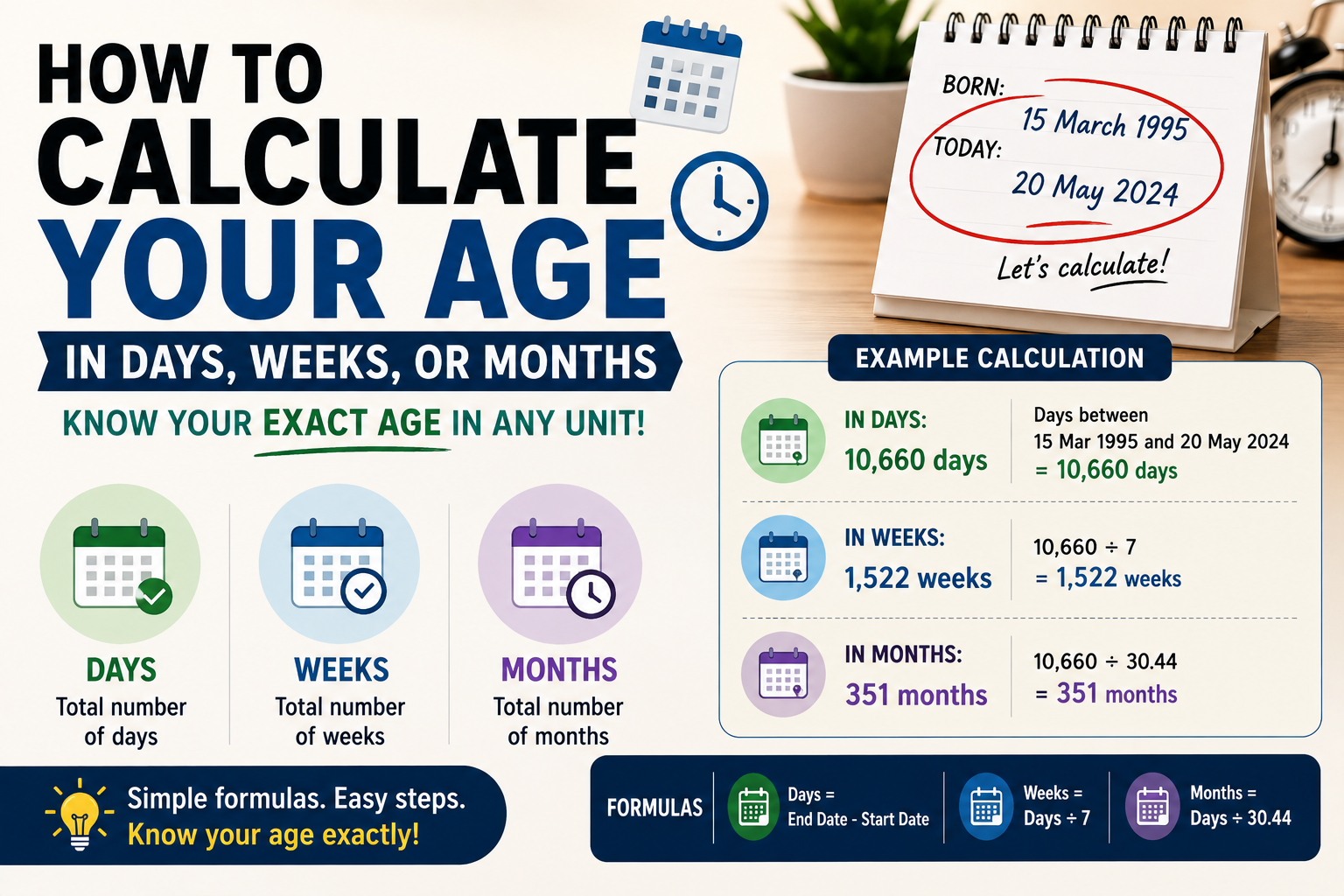
Your age in years is the number everyone knows, but calculating your exact age in days, weeks, or months is a genuinely different (and slightly trickier) calculation than it looks — mostly because months have different lengths and leap years throw off any calculation that assumes every year is exactly 365 days.
Why age calculations aren't as simple as they seem
A "year" is 365 days most of the time, but 366 days in a leap year. A "month" ranges from 28 to 31 days depending on which one. Any precise age calculation has to account for both of these irregularities rather than using flat averages, or the result drifts off by a noticeable margin over time.
Calculating age in complete years (the standard method)
- Subtract your birth year from the current year.
- If your birthday hasn't occurred yet this calendar year, subtract 1 from that result.
Someone born March 15, 1995, checking their age on January 10, 2026: 2026 − 1995 = 31, minus 1 since March hasn't happened yet this year = 30 years old.
Calculating age in total days
The most reliable method is counting the actual number of days between the birth date and today, accounting for every leap year in between — this is not a simple multiplication, since the number of leap years varies depending on the exact date range.
As a rough estimate: (years × 365.25) gives an approximation that accounts for the average effect of leap years, though it will be off by a day or two depending on the exact dates involved. For an exact count, calculating day-by-day (or using a calculator built for this) avoids the approximation error entirely.
Calculating age in weeks
Once you have the exact number of days: weeks = total days ÷ 7 (rounding down for complete weeks).
Calculating age in months
This one is genuinely irregular, since months vary in length. The standard approach: count complete calendar months between the two dates, then adjust for any remaining days that don't make up a full additional month. This is more involved than a simple division and is where manual calculation most often introduces small errors.
Why people look this up
- Pregnancy and infant milestones, which are frequently tracked in weeks rather than months or years.
- Legal and eligibility requirements that specify an exact age in days or months rather than years.
- Curiosity or milestone tracking — some people like to know exactly how many days they've been alive for a specific birthday.
Tip: if you need a precise day count for something official — a legal document, a medical form — use an exact calculation rather than the 365.25 approximation, since the difference of even a day or two can matter in that context.
Getting an exact number without the manual counting
Manually counting days and accounting for leap years and variable month lengths is tedious and easy to get slightly wrong. CalcMastermind's Age Calculator gives an exact breakdown in years, months, weeks, and days instantly.
The bottom line
Age in years is simple subtraction, but age in days, weeks, or months requires actually accounting for leap years and variable month lengths rather than relying on flat averages — the kind of precision that is much faster to get from a calculator than by counting manually.