

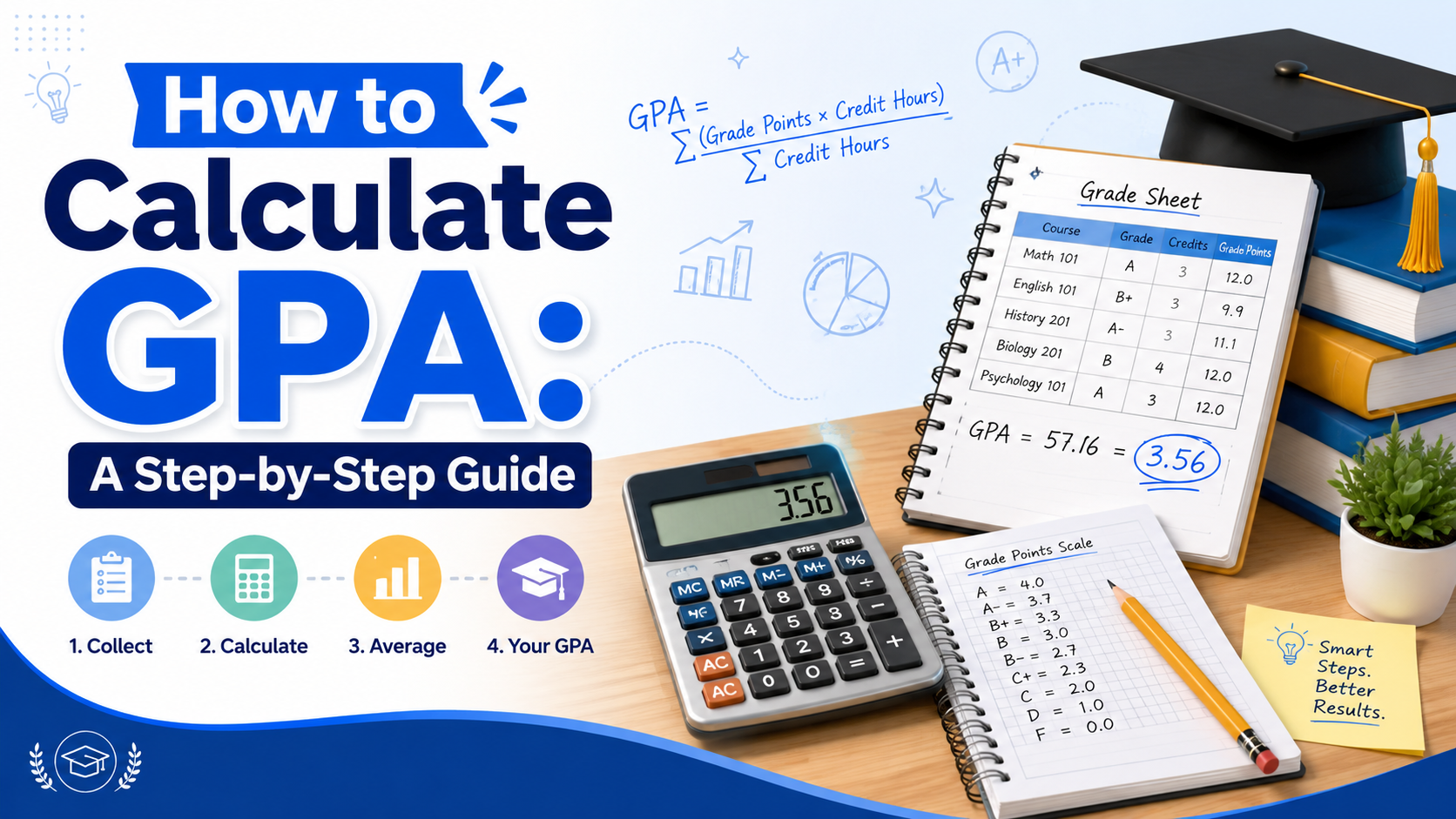
GPA looks like a single, simple number on a transcript, but calculating it correctly requires weighting each grade by how many credit hours the course was worth — a step that trips up a lot of students trying to work it out by hand for the first time. Here is exactly how it is calculated, step by step.
Step 1: convert each letter grade to grade points
Most US schools use a standard 4.0 scale:
- A = 4.0
- A- = 3.7
- B+ = 3.3
- B = 3.0
- B- = 2.7
- C+ = 2.3
- C = 2.0
- C- = 1.7
- D = 1.0
- F = 0.0
Some schools use slightly different scales, particularly for plus/minus grades, so it is worth confirming your specific institution's scale before relying on a calculation for anything official.
Step 2: multiply each grade point by the course's credit hours
This is the step that is easy to skip by accident, and it matters — a 3-credit course and a 1-credit course should not count equally toward your average.
Step 3: sum the results and divide by total credit hours
GPA = (sum of grade points × credit hours) / total credit hours
A worked example
| Course | Grade | Grade Points | Credit Hours | Points × Hours |
|---|---|---|---|---|
| Course A | A | 4.0 | 3 | 12.0 |
| Course B | B+ | 3.3 | 4 | 13.2 |
| Course C | A- | 3.7 | 3 | 11.1 |
| Course D | C | 2.0 | 2 | 4.0 |
Total points × hours: 12.0 + 13.2 + 11.1 + 4.0 = 40.3
Total credit hours: 3 + 4 + 3 + 2 = 12
GPA = 40.3 / 12 = 3.36
Why a straight average of grades gives the wrong number
Simply averaging the grade points (4.0 + 3.3 + 3.7 + 2.0) / 4 = 3.25 gives a different, incorrect result, because it treats every course as equally weighted regardless of credit hours. The credit-weighted calculation above is the one that actually matches how transcripts calculate official GPA.
Cumulative GPA vs. semester GPA
A semester GPA only includes that term's courses. A cumulative GPA includes every course taken across every term, using the same weighted formula but summed across your entire academic record — this is usually the number that matters most for graduate school applications, scholarships, and honors eligibility.
Tip: if you are trying to calculate what grade you need in a remaining course to hit a target cumulative GPA, work backward from the formula — multiply your target GPA by your total credit hours including the new course, subtract your current total points, and divide by the new course's credit hours to find the required grade points.
Skipping the manual math
The credit-weighting step is exactly where hand calculations go wrong most often, especially across a full semester or a multi-year cumulative GPA. CalcMastermind's GPA Calculator handles the weighting automatically across as many courses as you need.
The bottom line
GPA is a credit-weighted average, not a simple average of your grades — every course pulls the number based on how many credit hours it was worth, which is the detail most manual calculations miss.