

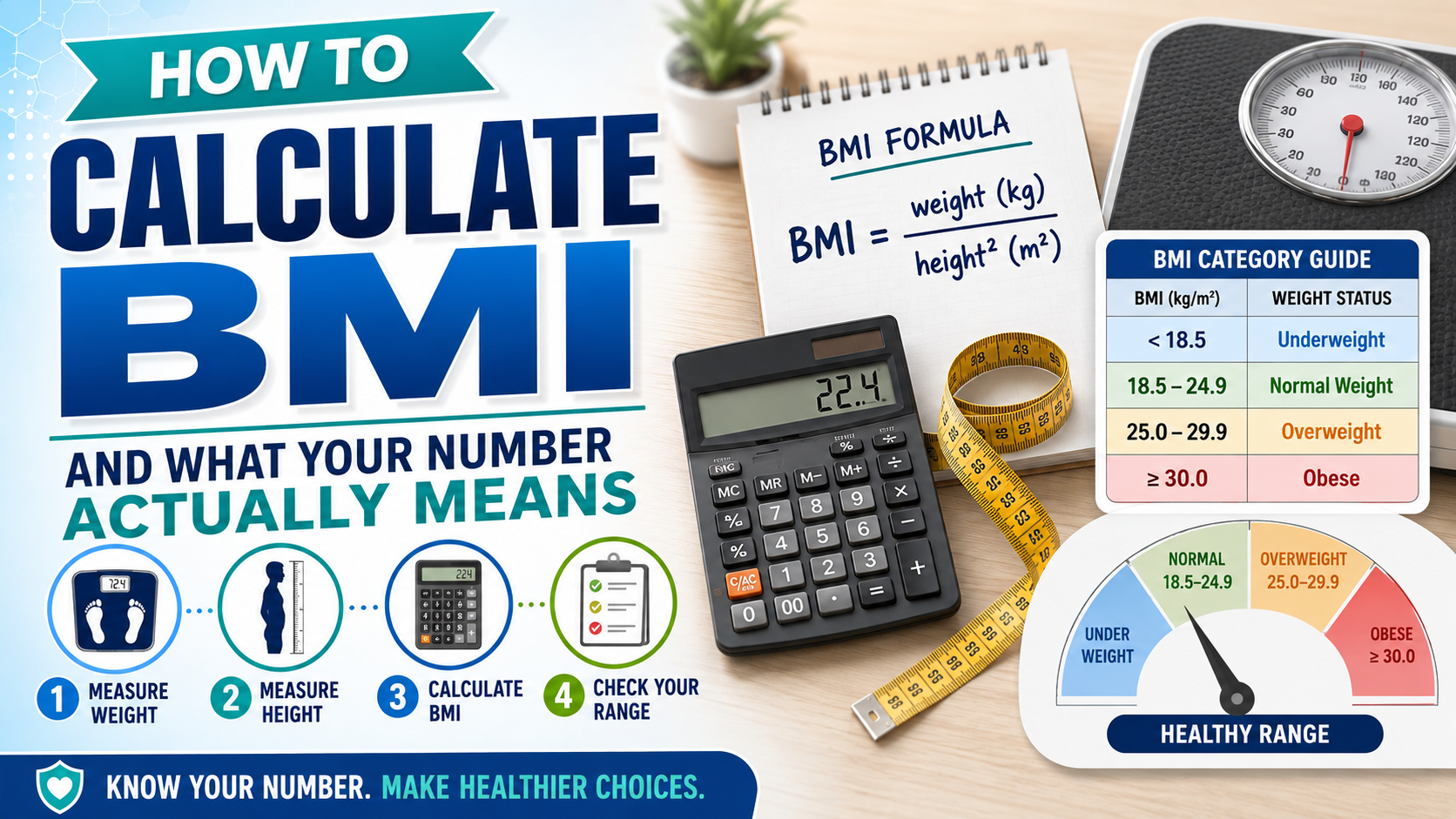
BMI shows up on medical forms, fitness apps, and insurance questionnaires constantly, but most people have never actually seen the formula behind it or understood what the resulting number is — and is not — telling them. Here is how it is calculated, what the categories mean, and where BMI genuinely falls short as a measurement.
The BMI formula
BMI is calculated from just two numbers: height and weight.
Metric: BMI = weight (kg) / height (m)²
Imperial: BMI = 703 × weight (lb) / height (in)²
Working through an example
For someone who is 5'8" (68 inches) and weighs 160 lbs:
BMI = 703 × 160 / 68² = 703 × 160 / 4,624 = 24.3
The standard BMI categories (WHO)
- Below 18.5 — Underweight
- 18.5 to 24.9 — Normal weight
- 25.0 to 29.9 — Overweight
- 30.0 and above — Obese
In the example above, a BMI of 24.3 falls within the "Normal weight" category.
What BMI does not account for
BMI was designed in the 1830s as a population-level statistical tool, not an individual diagnostic measurement, and it has real, well-documented limitations:
- Muscle mass. BMI cannot distinguish muscle from fat, which is why athletes and heavily muscled individuals frequently land in "overweight" or "obese" categories despite having low body fat.
- Body fat distribution. Two people with identical BMI can have very different health risk profiles depending on where their body fat is concentrated.
- Age and sex differences. BMI does not adjust for the natural differences in body composition between age groups or sexes.
- Frame size. Naturally larger or smaller bone structure is not factored in at all.
Why BMI is still widely used despite these limits
Even with its flaws, BMI remains useful precisely because it is quick, free, and requires no special equipment — for population-level health screening and general trend-tracking, it correlates reasonably well with health risk across large groups, even if it is a blunt instrument for any one individual.
Tip: if your BMI falls outside the "normal" range but you have significant muscle mass or an athletic build, body fat percentage or waist-to-hip ratio are generally considered more informative individual measurements than BMI alone.
Calculating your own BMI
The formula above is simple enough to do by hand, but CalcMastermind's BMI Calculator handles the math instantly and shows your WHO category automatically, without needing to convert units or square anything yourself.
The bottom line
BMI is a simple ratio of weight to height, useful as a quick, general screening tool, but it was never designed to capture the full picture of an individual's health — muscle mass, fat distribution, and frame size all matter too, and are worth considering alongside the number rather than instead of it.