

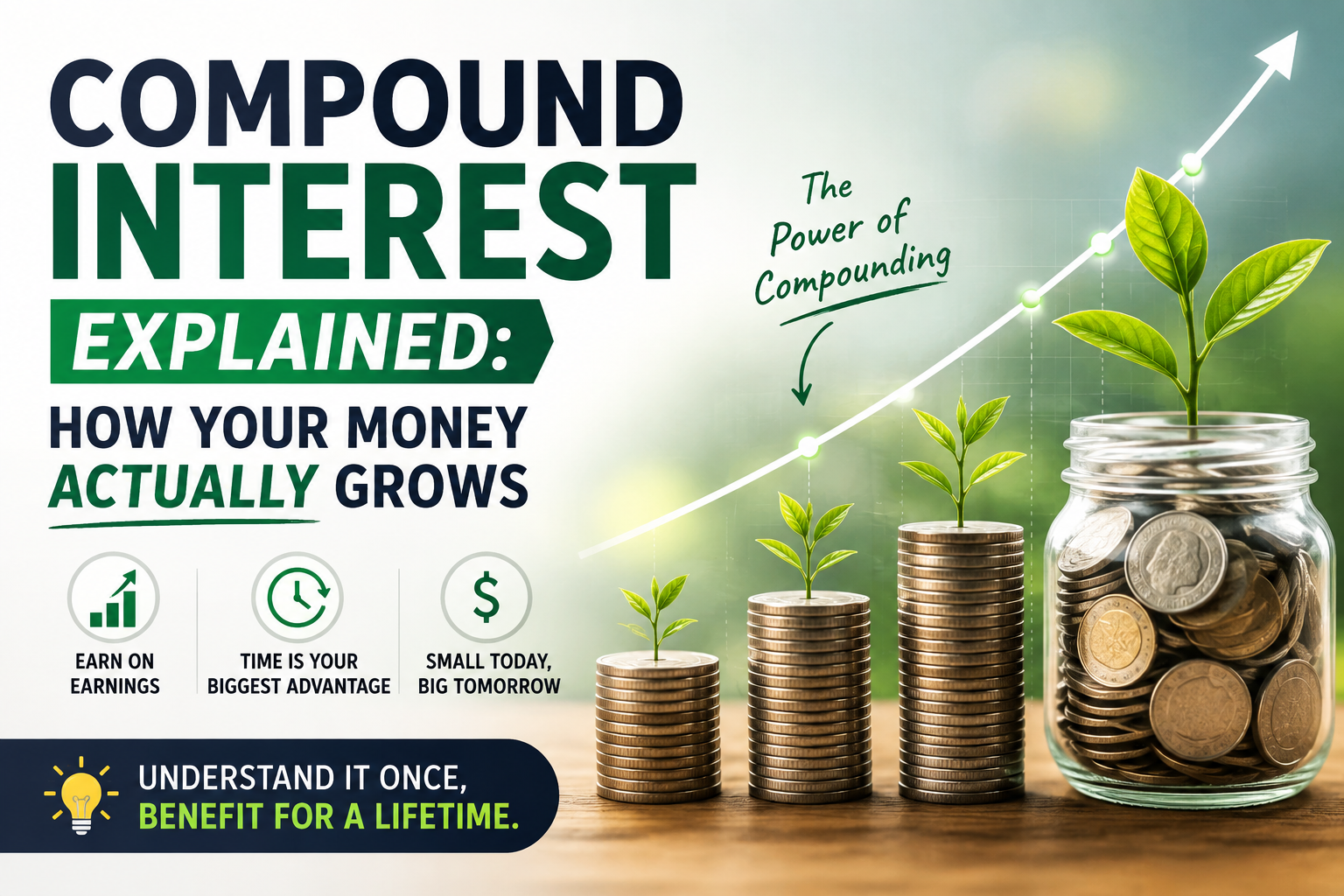
"Compound interest is the eighth wonder of the world" gets quoted constantly, but the actual mechanics behind why it matters so much rarely get explained clearly. Once you see the formula and a real example side by side, the difference between compound and simple growth stops being an abstract idea and starts being something you can actually plan around.
Simple interest vs. compound interest
Simple interest is calculated only on your original principal, every time. Compound interest is calculated on your principal plus whatever interest has already accumulated — meaning your interest starts earning its own interest, which is the entire reason compounding accelerates growth over time.
The compound interest formula
A = P(1 + r/n)^(nt)
- A — the final amount after growth
- P — your starting principal
- r — the annual interest rate (as a decimal)
- n — how many times per year interest compounds (12 for monthly, 1 for annually)
- t — the number of years
A concrete example
Invest $10,000 at a 7% annual return, compounded monthly, for 20 years:
- P = 10,000
- r = 0.07
- n = 12
- t = 20
That works out to roughly $40,387 after 20 years — more than four times the original investment, with no additional money added beyond the initial $10,000.
Why the compounding frequency matters (a little) less than time does
Switching that same example from monthly to annual compounding only changes the final result by a relatively small amount — a few hundred dollars either way. What actually moves the number dramatically is time. Extend the same investment from 20 years to 30 years, and the final amount jumps to roughly $76,123 — nearly double, from ten extra years of the same rate doing its work.
What this means practically
- Starting early matters more than starting big. A smaller amount invested a decade earlier can end up larger than a bigger amount invested later, purely because compounding needs time to do the heavy lifting.
- Consistent contributions amplify the effect further. The formula above covers a single lump sum; adding regular contributions on top compounds even faster, since each new contribution starts its own compounding clock.
- The same math works against you with debt. Credit card balances and some loans compound the same way, which is exactly why carrying a balance grows more expensive the longer it sits unpaid.
Tip: the "Rule of 72" is a quick mental shortcut — divide 72 by your annual interest rate to estimate roughly how many years it takes an investment to double. At 7%, that is about 10.3 years.
Running your own numbers
Working through the formula by hand is useful for understanding the mechanics, but comparing multiple scenarios — different rates, contribution amounts, or time horizons — gets tedious fast. CalcMastermind's Compound Interest Calculator handles this instantly and lets you see how monthly versus annual compounding, or five extra years, actually changes your outcome.
The bottom line
Compound interest grows faster than simple interest specifically because interest starts earning interest of its own — and the single biggest lever in that formula is time, not the rate itself. The earlier money starts compounding, the less it needs any other advantage to end up ahead.